
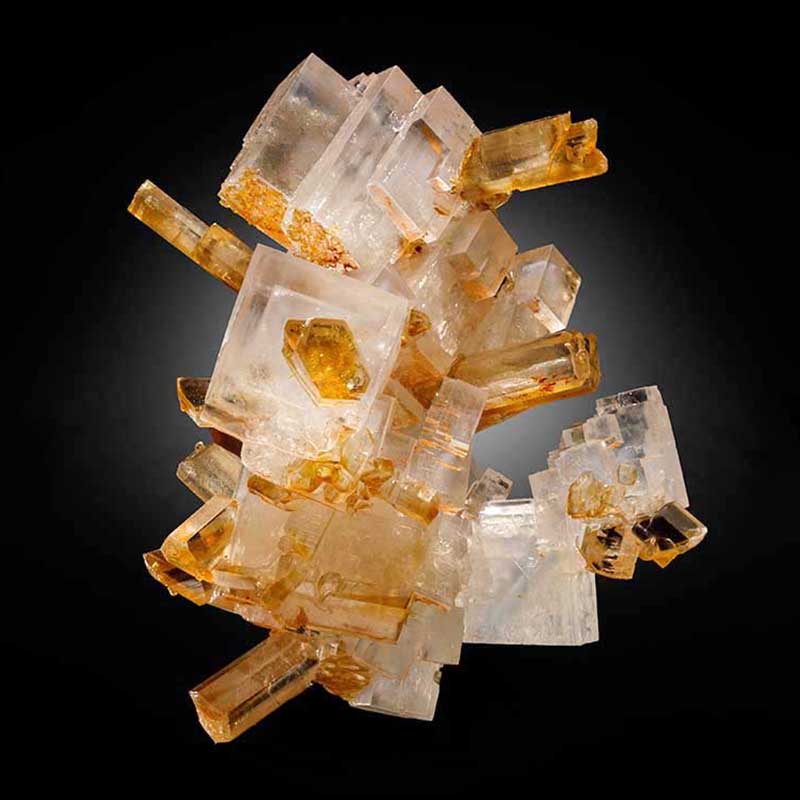
Although salt is a common resource, it rarely crystallizes in substantial sizes, and even less often in collectible form. Halite represents a macrocrystalline expression of salt, forming in regions once occupied by ancient salt lakes and seas that have long since evaporated. Beyond its immediate relatability as crystallized salt, halite is highly prized by collectors for its dramatic crystal forms and, in exceptional examples, its striking fluorescence.
This specimen, composed of halite with associated selenite, originates from Thuringia, Germany—the only locality in the world known to produce this rare mineral pairing. It was among the ten largest halite specimens recovered from a rare find at the Sollstedt Potash Works (formerly the Karl Marx Potash Works), mined from 1902 to 1991. The well-formed cubic halite is accented by elongated selenite crystals in warm yellow-orange tones that radiate from the central mass, creating depth, contrast, and dynamic visual movement. When illuminated under short-wave ultraviolet light, the specimen fluoresces a vivid orange-red color, adding yet another dimension to this exceptional example.