
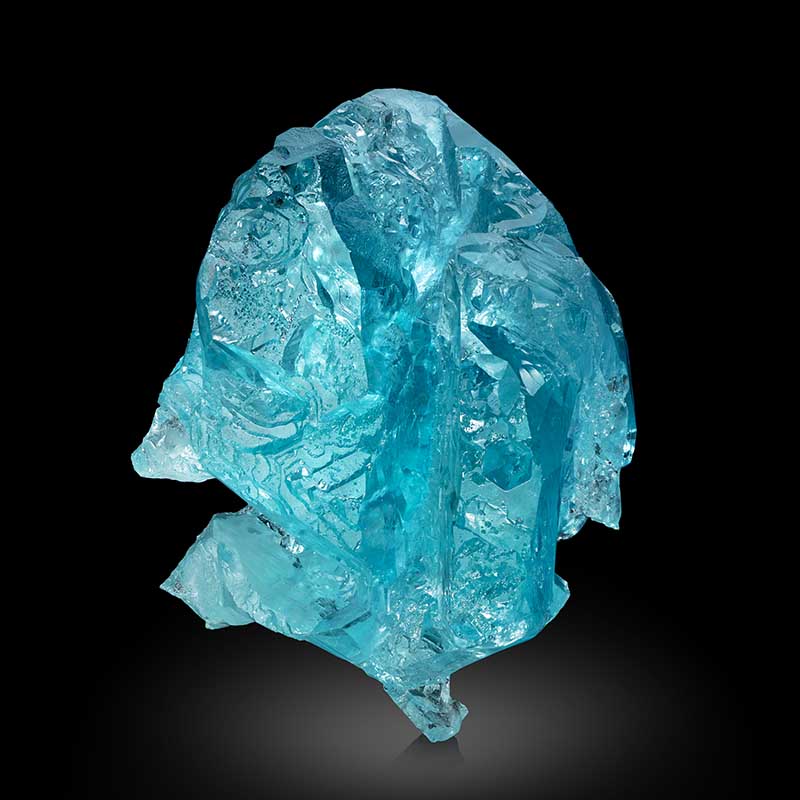
This sculptural aquamarine from Pedra Azul, in Brazil’s renowned Jequitinhonha Valley, is a striking example of the region’s distinctive beryl production. Unlike the more familiar hexagonal, prismatic forms, this piece exhibits an unusually fluid morphology, often referred to as “etched.” Its surfaces appear as though chiseled by a sculptor, but closer inspection reveals geometric faces, evidence of dissolution, a geological process in which a solid transitions into a liquid phase. In mineralogy, this often leads to partial recrystallization, where the crystal reforms selectively along its outer surfaces, dramatically altering the overall shape. Brazilian aquamarines are particularly known for such atypical, highly individualized forms. They are also celebrated for their high clarity and richly saturated blue hues, all of which are beautifully showcased here.
Adding to its mineralogical interest is the presence of negative crystal formations on the underside—hollow, sharply formed voids with distinct geometric definition, likely a remnant of the dissolution of now-absent crystals during the specimen’s formation. These hidden features offer a window into the crystal’s developmental history and are a rewarding discovery for collectors attuned to the intricacies of crystallization. At 9 cm tall and over 7 cm across, this aquamarine is both visually impactful and rich with geological narrative.