
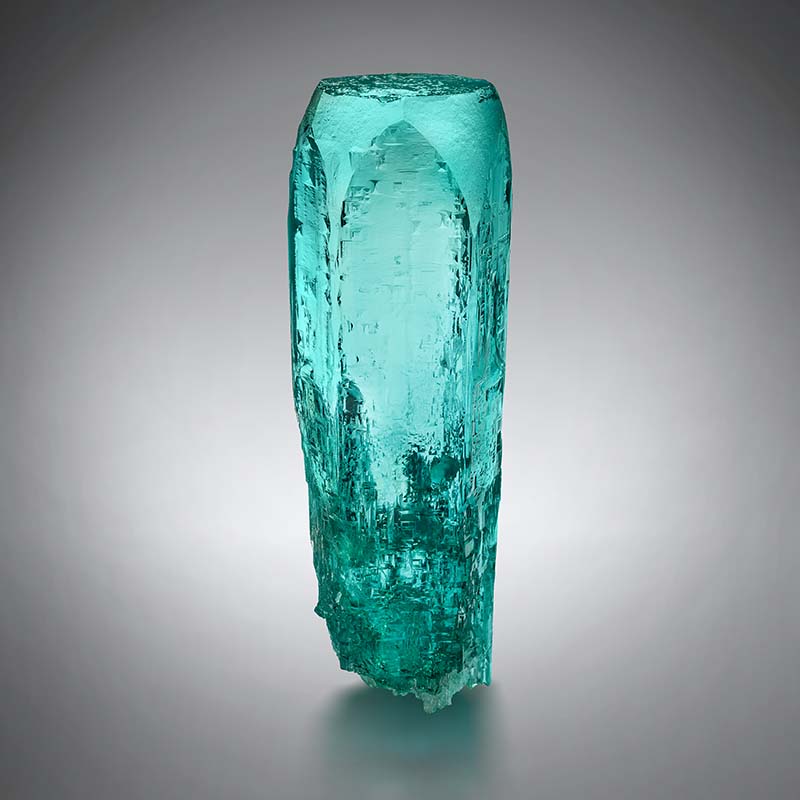
Brazilian aquamarine is renowned for its exceptional clarity, color, and glass-like luster, with the finest examples evoking vials of pure seawater. While aquamarine is a hexagonal variety of beryl, crystals from Brazil often display distinctive barrel-shaped forms resulting from natural corrosion and dissolution during growth. Dissolution is a geological process in which portions of a crystal are partially decomposed, allowing subsequent reconfiguration and recrystallization. When conditions are favorable, this process can produce rare, re-terminated crystals with sculptural forms and refined surface detail that distinguish them from more conventional examples.
The Medina Mine is among the most important localities worldwide for fine-caliber aquamarine. Although most Brazilian aquamarine was recovered between the 1960s and 1980s, the mine lay largely dormant until 1995, when a legendary water-filled pocket was breached, revealing fifteen exceptional free-floating crystals. These pieces exhibited true blue color, brilliant luster, and sharply defined basal pinacoid terminations. Among them, this specimen stood apart as the largest and most perfectly formed example of the recovery. Its size, clarity, color, and remarkable crystallographic refinement place it among the most important aquamarines ever recovered from the Medina Mine and firmly within the highest echelon of the species.